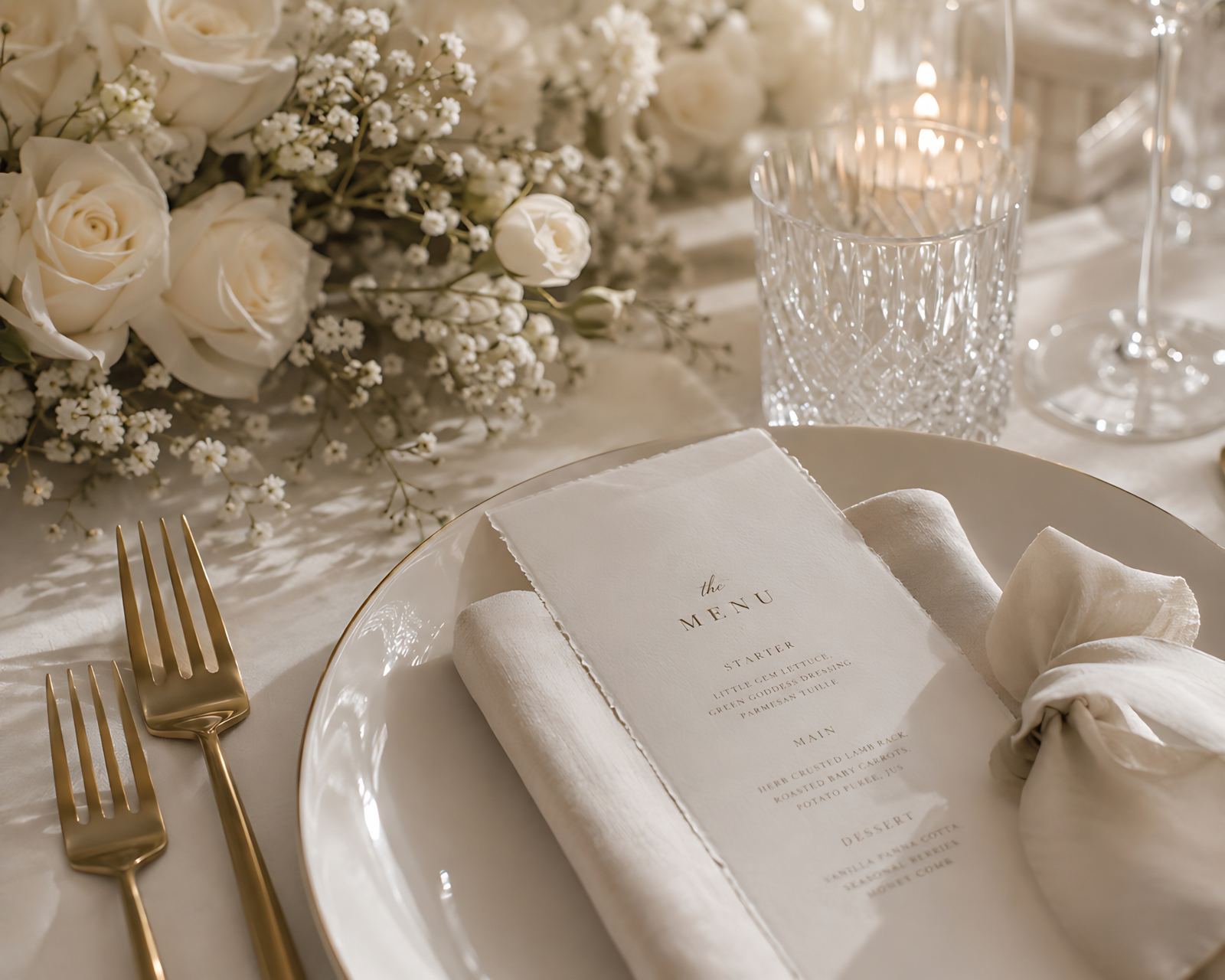
I've come to think of a place setting as the quietest form of hospitality there is. Long before a guest tastes anything, they've already read the table, noticing the weight of a linen napkin, the placement of a name card, whether a glass was set down with care or simply put there.
None of this is about abundance. Some of the most considered tables I return to in my mind are also the simplest: a single stem instead of an arrangement, a menu card with nothing but the essentials printed on it, cutlery chosen once and chosen well rather than layered on to look generous. Restraint, done properly, reads as confidence. It tells a guest that every choice on the table was made on purpose, not filled in because a template called for it.
This is where I spend more time than people expect, working from linen through to the smallest place card. Not because the details need to impress anyone, but because they are, quietly, a form of care. A guest who is seated at a table with the right amount of space, the right weight of glass and a name spelled correctly feels that, even if they couldn't say exactly why.
For destination celebrations in particular, this becomes even more deliberate. Local flowers, local linen textures, and the natural stone or wood already present at a venue are usually better collaborators than anything shipped in. In Switzerland that might mean working with the cool, clean lines already present at a lakeside property; on the Costa Blanca it's often about warmth, the kind that comes from sun-worn ceramics and olive branches, a table that looks like it belongs to the Mediterranean rather than one imported onto it.
If there's a single principle I keep coming back to, it's this: a table should never compete with the people sitting at it. The china, the candlelight and the small printed menu all exist to support the evening, not to perform for it. That's the difference, I think, between decoration and design.